Sunday, December 22, 2013

mHealth: Empowering the Patient

Deloitte recently posted an infographic about the benefits (and the risks) of mHealth.  To summarize, the best thing about mHealth (or mobile health) is that it truly empowers the patient.

By using an app on a smartphone or tablet, it will be easier for individuals to monitor and manage health issues such as blood sugar or breathing function.  As the use of smart technology increases and the price of these devices decrease, use of these mHealth apps will continue to rise.

This is not to say that mHealth is without risk.  As this technology is new, reliability of these diagnoses may not be as accurate and reliable.  There is a risk of user error in this self-diagnosis.

In conclusion, mHealth is a rapidly growing field.  Any technology that helps empower the patient will help shift from curative medicine to preventative medicine.  This shift will hopefully lead to better health outcomes meaning a healthier populace and decreased healthcare expenditures.

Click image on right to view the entire infographic.

Sunday, December 15, 2013

Failing Faster in Healthcare

"Fail Fast, Fail Often" is a mantra often used in technology and in start ups.  The thought is by achieving "calculated" failures, there is much to be learned and if this learning is optimized, it can lead to increased efficiency and breakthrough results.

In the past, healthcare has lagged in innovation.  Oftentimes building large, bulky, proprietary systems, it was more "Fail Slow, Fail Infrequently".  This has lead to some healthcare providers with outdated business processes and technology.

Price Waterhouse writes a great article on this topic and the key takeaway is that innovation must be structured.  Larger, more established companies will need to continue to innovate to compete with new entrants in the healthcare market.  By implementing this "Fail Fast, Fail Often" mantra in a structured environment, it will allow for increased efficiency when innovating.  

Friday, November 15, 2013

Misconceptions about Healthcare Spending

Came across this great article by Olga Khazan,  "Obesity, Not Old People, Is Making Healthcare Expensive".  Check out the main bullet points:


  • The aging population doesn't account for most medical spending.
  • The U.S. doesn't have the best healthcare system in the world.
  • Spending more on IT is not necessarily making our health system more cost-efficient.
  • The rate of increase in medical costs has actually slowed.
  • Consumers aren't the ones paying for an increasing share of medical costs.
Most interesting for me is the fourth point regarding rate of medical spending actually decreasing.  I oftentimes see papers and presentations citing the constant increase in percentage of US GDP spent on healthcare.  But if you look at the graph above, you see that this spending increase has actually slowed down dramatically and is more an outcome of inflation.  

Tuesday, November 5, 2013

Can Analytics Save Obamacare?

I have had a few intelligent conversations (and a few not so intelligent) about what is wrong with the ACA roll-out and what can be done to fixed it.  I'm not talking about policy or politics, simply the actual ACA website, www.healthcare.gov.  In my opinion this is where they went wrong:
  1. Outdated project management methodology:  In my project management classes, it would be typical to talk about how NOT to implement a project.  The common example was the DOD (Department of Defense) using a "Waterfall model".  This was the common methodology used by the government for all IT projects in the 80's and 90's...and also a reason why many of these projects failed.  An estimate is that 75% of all of these projects failed or were never used!  And you may have guessed it, ACA used this waterfall model for development instead of a more modern approach such as lean or agile methodology
  2. The best and the brightest?  It is questionable whether or not the best computer programmers and IT project managers were tasked to this project.  Working for the government requires many hoops to be jumped, one of which is American Citizenship.  Also, government contracts are often awarded by low cost as opposed to merit.
The government is now doing what they can to make bug fixes.  Although the political issues will probably always be there when discussing the ACA, it looks like these technological issues need to be resolved first.  Bug fixes at this point are the proverbial "lipstick on the pig" because the framework that the ACA is built on is not built for optimization and growth.  

Where do analytics belong in this equation?  Analytics can help define the desired outcomes and help optimize the system once these bugs are resolved.  Even after these bugs are taken care of, the system will need to be continually revised and updated to provide the best patient outcomes.  This is where I feel analytics can come in.

Monday, October 21, 2013

IBM Executive Report on Optimizing Healthcare Outcomes Using Analytics

current ecosystem of how data flows across stakeholders
Wow, IBM just posted a great white paper that does a great job of articulating the current state of analytics and spells out some recommendations at the end.  Click here for white paper.

Here are the key takeaways for those who don't feel like reading:
  • Optimize analytics within  your company
  • Encourage disrupted collaboration
  • Accept no objections.
Read the paper for more information.  But as the paper concludes, "In the information age, data rules".

Tuesday, October 15, 2013

IBM's Watson Wants to Fix America's Doctor Shortage

"The supercomputer's greatest opponent may be the American healthcare system"

Watson Path's concept map
I thought Watson defeating Jeopardy champs, Ken Jennings and Brad Rutter was impressive:

But check out WatsonPaths and how it can help physicians use data to make decisions. http://www.youtube.com/watch?v=07XPEqkHJ6U

Mind Blown.

I was just chatting with my coworker about Watson and how IBM should set their sights higher than just competing with Siri (Apple) and maybe taking on Google:  the algorithm IBM has created is far above anything Google currently does with search.  

Looks like IBM has their sights set even higher.  Read more about Watson Path and how it can potentially help fix America's doctor shortage here.

Sunday, October 6, 2013

The 'Big Data' Revolution in Healthcare


There is a great paper put together by the people at Mckinsey & Company entitled "The 'big data' revolution in healthcare: accelerating value and innovation" (right click link to download entire paper).  This 22 page paper published earlier this year is a great primer on big data (and analytics) place in this sector.

forces demanding insights:  enter "big data"
I recommend reading the entire thing.  But the summary is a good bottom line of the papers analysis and subsequent recommendations:

"Big-data initiatives have the potential to transform health care. Stakeholders that are committed to innovation, willing to build their capabilities, and open to a new view of value will likely be the first to reap the rewards of big data and help patients achieve better outcomes."


Thursday, October 3, 2013

Obamacare Online = Big Data Repository?

While everyone has recently been talking about the government shutdown (for good reason), another HUGE thing that just happened was that ObamaCare (Affordable Care Act) went online! https://www.healthcare.gov/

OK, so the process and benefits might be a little confusing. But once you get into the application (might take a while due to the traffic), it asks for alot of data!

ObamaCare is positioning itself to be the biggest healthcare data repository in the US (and perhaps the world)! What is the government planning to do with all this data?

There will be an opportunity for healthcare providers to mine and analyze this data. If healthcare providers can leverage this data like in business, real insights can be drawn and infrastructure can hopefully be improved.

Wednesday, September 25, 2013

Practice Fusion

Wow the "blockbuster that the digital health space has been waiting for".

Practice Fusion just landed 70 million dollars to bring a big data cure to the healthcare crisis!

Hopefully this will inspire other entrepreneurial minds to look at healthcare industry. And also curious how this will affect the big EMR systems (EPIC, Vista, Cerner, etc).

Click to read more about this latest investment http://techcrunch.com/2013/09/24/looking-beyond-medical-records-practice-fusion-lands-a-whopping-70m-to-bring-a-big-data-cure-to-the-healthcare-crisis/.

Friday, September 20, 2013

Nate Silver

If you aren't familiar with Nate Silver, he's famous for predicting 49 out of 50 states correctly in the 2008 presidential election and all 50 correct in the 2012 election.


Thing that resonated with me most in his talk? How someone data-driven (like myself) can appear unconfident when speaking and answering. The reason? They realize that even when speaking with 95% certainty, there is that 5% chance of being incorrect. Someone else who may sound confident may only be 51% confident they are correct. Definitely something to think about at your next meeting at work.

Great talk though, very cool to see him live. He recently received a ton of money to move over to ESPN. Check it out www.fivethirtyeight

Monday, August 5, 2013

AARRR: Pirate Metrics


OK, pirate metrics isn't about that type of pirate.  It is actually a 5 step framework to use when analyzing analytic data you have captured.

I actually did some research on it and put together a presentation for work.  Attached is the Powerpoint presentation (minus all of the work specific takeaways).  Hopefully there is something here that you can use to help grow traffic and revenue for your website.

Pirate Metrics: or AARRR

Thursday, August 1, 2013

Value to Vision

Here's a great read sent to me from my friend Jason.  It is called "Value to Vision" and it a Management Report put together by MIT Sloan and SAS.  Jason is actually Director of Financial Planning at Providence Health where Analytics is a huge part of their day to day.

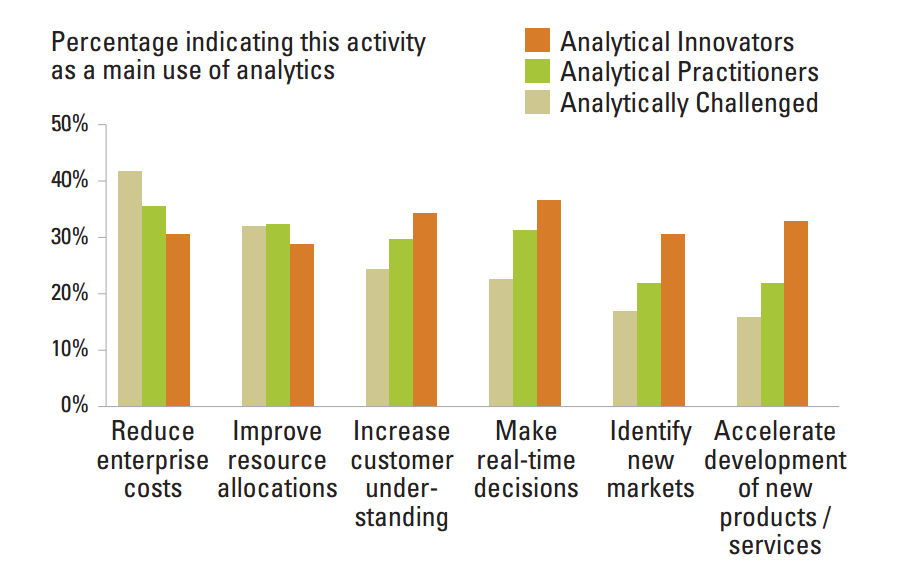
The document is 22 pages long but a really interesting read.  Here are the key takeaways from the article.  C Level executives who use analytics believe that:
  • Data is a core asset of a company.  It can be used to enhance operations, customer service, marketing and strategy.
  • More effective us of data equals faster results
  • Support for analytics by senior management who embrace new ideas can lead to a competitive advantage.
Read more here!
Value to Vision - Data Analytics Report

EDIT:  had to remove link to full article.  Updated with a link to the preview!  Enjoy!

Monday, July 1, 2013

Great Analytics Primer

I just came across a great article that someone posted on LinkedIn.  Great link and the title speaks for itself:

What the hell is Analytics Anyways?
This article puts the world of analytics in lay mans terms:  cites real world examples that anyone can identify with.  These examples include:
  • The world of sports
  • Love
  • Business
  • and.... HEALTHCARE!
Key takeaway:  The amount of data collected is growing at an EXPONENTIAL rate.  We need to continue to find ways to keep up with the data: through tracking and analyzing.  This data can be the key to improved outcomes!

Friday, June 7, 2013

Infographic

Key takeaway:  proper use of business analytics in healthcare setting improves outcomes (IE SAVES LIVES).


Tuesday, June 4, 2013

Restyling Medical Records

My coworker shared a great link with me, "How restyling the mundane medical record could improve healthcare".  The article displays the results of a white house sponsored contest focusing on redesign of EMR's (Electronic Medical Records).

My favorite line of the article, "Don't give patients an archive, give them a strategy."

This in my mind is the best way to look at EMR's going forward: as a strategic enabler and more than just a collection of data.

Saturday, June 1, 2013

Blog Goals

Goals of blog:
  1. Sharing cool content:  So this might be a video, link, picture, etc.
  2. Creating cool content:  What I've noticed in the recent twitter/pinterest/tumblr era, there is more sharing of other people's content than actual creation of content.  While other people have great ideas, I have some ideas on how to improve on them.
  3. Tracking changes in the industry:  Healthcare and how it interacts with technology is ever-changing.  I figure the more I research it for my blog, the more I can keep up with this ever-changing industry
  4. Personal reference:  This is my online work diary if you will.  Goal is to publish meaningful content that I will want to reference in the future.